
Few images in gaming are as instantly recognizable yet as quietly profound as the Royal Hyrule Crest from The Legend of Zelda series. While casual fans may recall the familiar silhouette of the Hylian Shield or the gilded ornaments on Hyrule Castle, the crest itself is often treated as simple decoration. In truth, it is a carefully woven tapestry—a visual poem that stitches together eras, deities, and the very soul of Hyrule. Like a weathered astrolabe, it charts a course not across the seas, but through the deep currents of the franchise’s mythology.
Introduced to players in Ocarina of Time (1998), the Royal Hyrule Crest would not find its full narrative weight until Skyward Sword (2011) peeled back the layers of the series’ origin. It is a striking case of retroactive storytelling: a symbol that appeared decades before its own fictional genesis was written. This chronological inversion makes the crest something of a temporal whisper, a promise whispered by developers who, like cartographers working backwards from a known coastline, gradually filled in the continent of Hyrule’s soul.
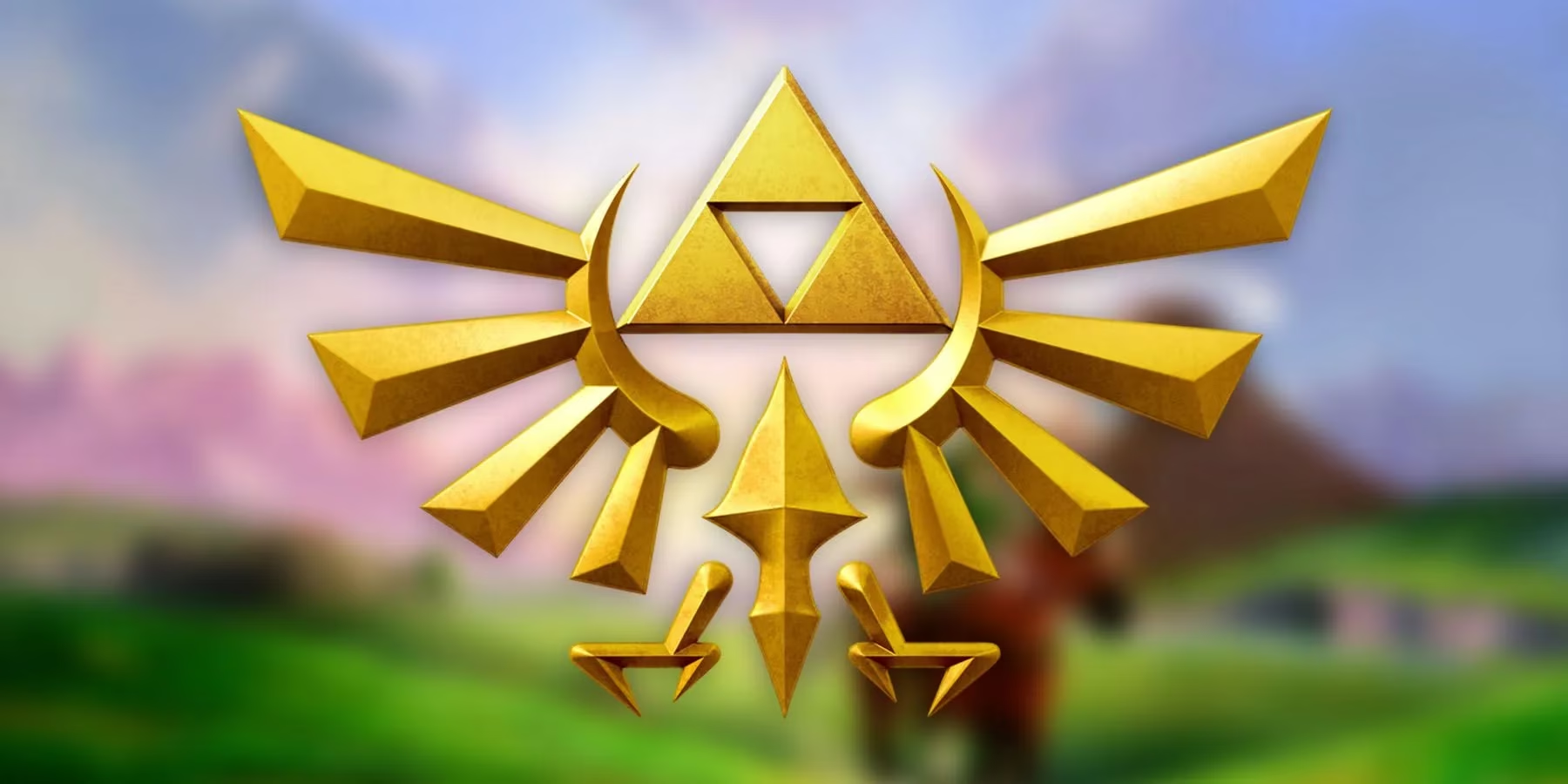
At the heart of the crest lie two inseparable components, each a fingerprint of the divine. The first is the symmetrical pair of sweeping wings, often mistaken for abstract flourishes. They are, in fact, an homage to the Crimson Loftwing—the personal bird of the hero who lived in the sky era before Hyrule’s very name was planted in the soil. These wings are not merely ornamental; they are heraldic sentinels, frozen in mid-beat, guarding the memory of a bond that predates the land itself. They remind us that before the sword and the shield, there was the sky and the trust between a hero and his bird.
The second element is the Triforce, set above the wings like a crown of pure geometry. Its three golden triangles—Wisdom, Courage, and Power—are the prism through which the entire series refracts its conflicts. Created by the Golden Goddesses Din, Nayru, and Farore, the Triforce was entrusted to the Goddess Hylia and eventually to the Royal Family of Hyrule. Its placement on the crest is not merely decorative but deeply custodial: it declares that the bloodline of Princess Zelda carries the weight of this sacred charge. The Triforce sits above the loftwing as if suspended by an invisible thread, a three-petaled cosmic bloom forever hovering just out of mortal reach, yet always guiding the destiny of Hyrule.
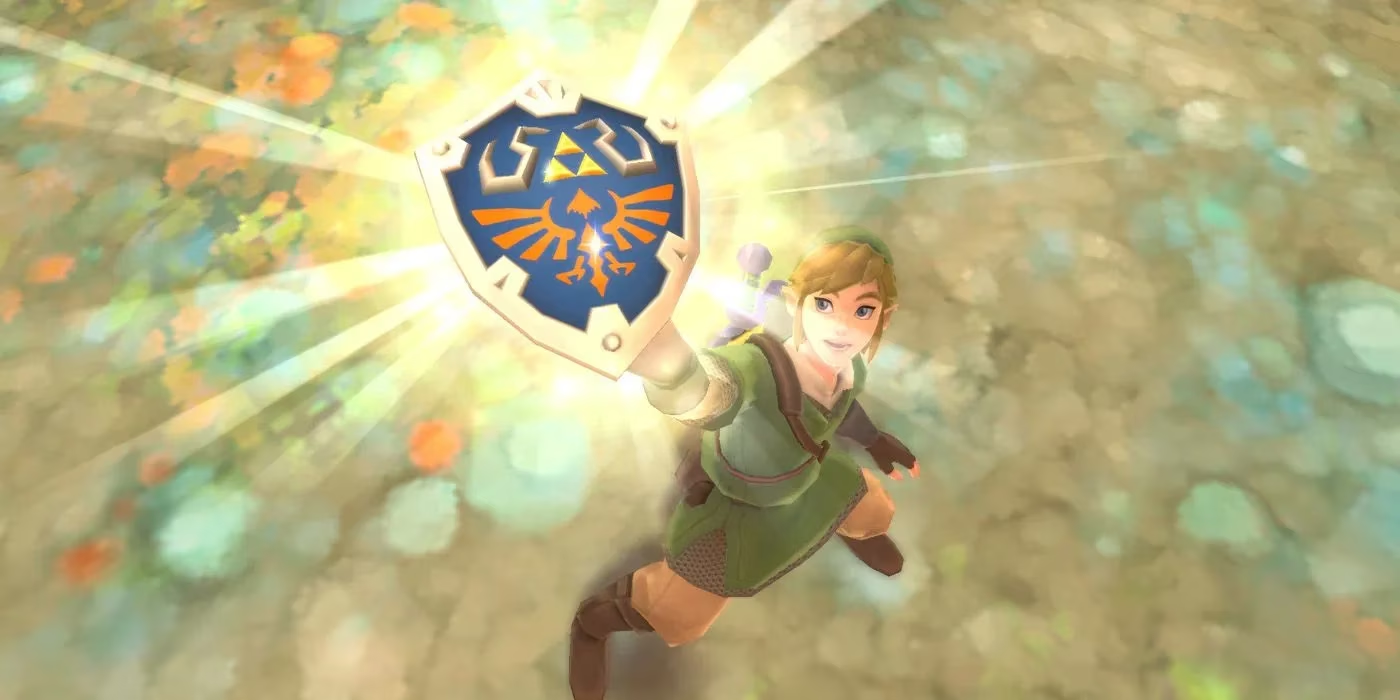
The shield from Skyward Sword shown above reveals the crest in one of its most intimate roles—not as a distant royal cipher, but as a companion pressed against every sword swing. Here, the crest becomes a tactile object of faith, worn into battle by a silent farm boy destined to become a legend. That shield’s surface, repeatedly scarred by Deku Babas and Lynel charges, paradoxically polishes the symbol into something even brighter: the memory of a promise that transcends flesh.
What makes the Royal Hyrule Crest endure is its remarkable adaptability. It graces guard uniforms in Breath of the Wild and Tears of the Kingdom despite the Triforce itself remaining conspicuously absent from those games’ explicit narratives. This is no oversight. By 2026, with multiple post-Tears of the Kingdom retrospectives underscoring the series’ layered iconography, scholars and fans alike have begun to see the crest as a form of pictorial anchor—a silent insistence that even when the Triforce sleeps, its shadow still shapes the land. The crest whispers that the old gods never truly vanish; they simply learn to hide in plain sight, folded into the wings of a bird.
This is where the crest transforms into something even stranger and more beautiful: a mnemonic knot that binds disparate timelines. From the Great Sea of The Wind Waker to the twilight-shrouded Hyrule of Twilight Princess, the same design reappears like a persistent dream. It functions as a thread of silk drawn through the labyrinth of the series’ continuity, its color never fading regardless of how far the branching realities stretch. In a franchise that has openly embraced multiple timelines, the crest acts as a fixed point—a north star for fans drowning in charts.
Looking ahead, the Royal Hyrule Crest is poised to remain the series’ quiet heartbeat. Whether future installments revisit the skies or plunge into even deeper ruins, this emblem will likely persist, not as a relic but as a living witness. Its genius lies in its economy: two wings to carry a legend, three triangles to hold the infinite. It needs no words because it has already spoken through decades of adventure. And as any Hylian knows, some truths are too vast for language—they can only be carved into a shield and carried home. ⚔️✨
Comments