
The enduring allure of The Legend of Zelda: Tears of the Kingdom continues to spark remarkable creativity long after its 2023 debut. Having sold nearly 20 million copies in its first year and walked away with multiple Game Awards nominations—including Game of the Year—the title remains a benchmark for open‑world adventure. Its vast community channels that energy into a steady stream of paintings, cosplay, and sculptures that reinterpret the game’s mythic imagery. Among these tributes, the ethereal Light Dragon stands out as a subject that blends elegance with otherworldly mystery, and a recent clay miniature captures its essence with breathtaking precision.
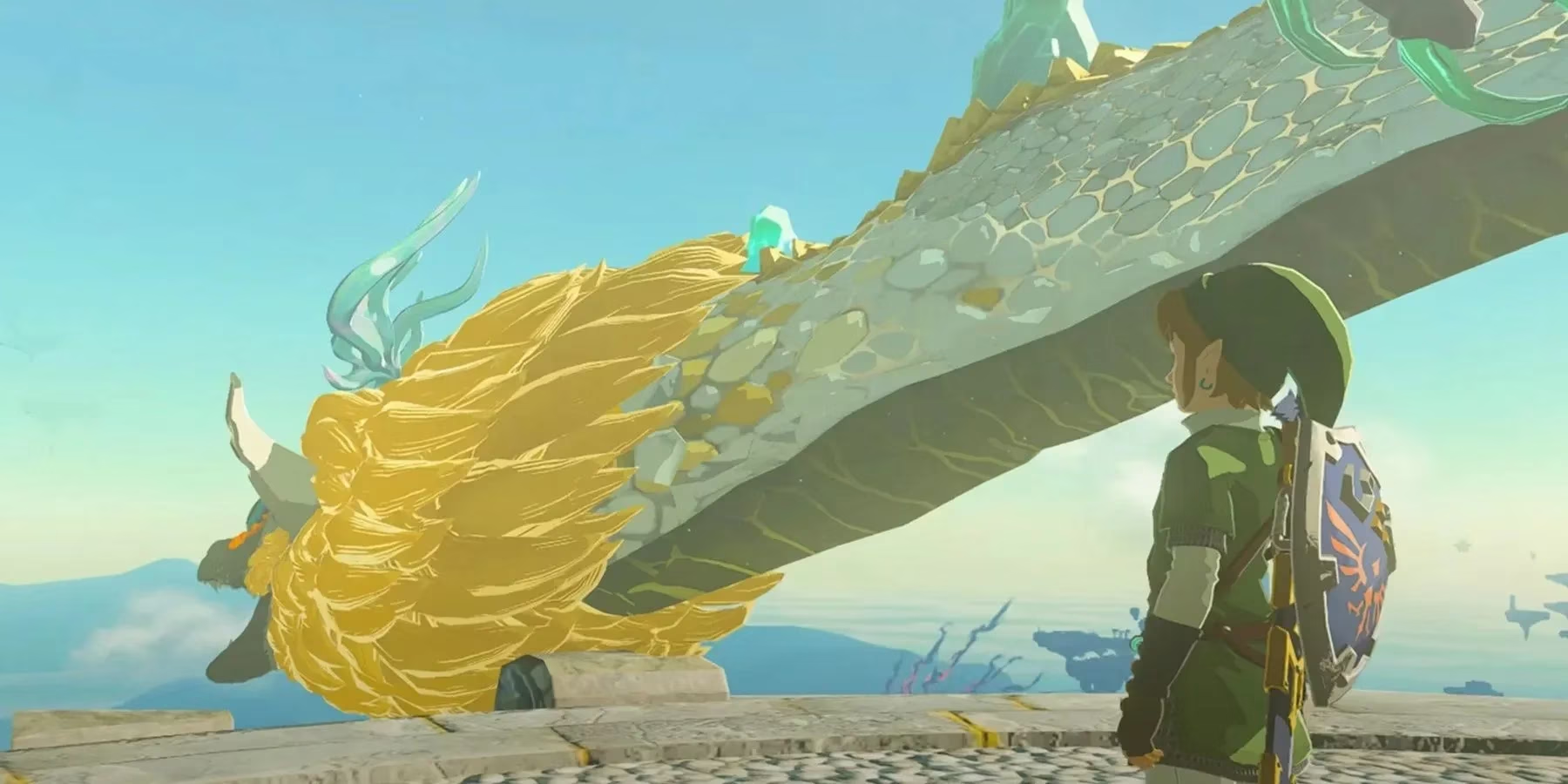
The Light Dragon is one of four ancient sky serpents that silently patrol the floating archipelagoes of Hyrule. Unlike the territorial elemental dragons, this creature is bound to a deeper narrative thread, silently carrying a precious secret across the heavens. Its elongated, pearlescent body glistens with a soft golden mane, regal horns, and rows of crystalline spikes that refract the sun into faint prismatic glints. A stone shrine nestled on its back anchors it to the lore of the Zonai civilization, and anyone who manages to ride the dragon is treated to a meditative journey above the clouds. This design—simultaneously delicate and monumental—poses a distinct challenge for craftspeople hoping to shrink it down to tabletop scale.
Redditor LunarRose5 accepted that challenge with a polymer‑clay sculpture that looks as if it descended straight from the game’s concept art. The artist mounted the dragon atop a faithfully reproduced shrine pedestal, freezing it in a trio of poses that convey coiled poise and restless energy. Every spike and ridged scale was shaped by hand, then painted with a pearlescent white base and accented with faint azure shading. What truly elevates the piece is the use of a glow‑in‑the‑dark pigment along the spines and mane. When the lights dim, the miniature transforms—the spikes radiate a cool, phosphorescent halo, giving the dragon an unearthly, dreamlike aura that mirrors the magical atmosphere of Hyrule’s skyward reaches.
The sculptural accuracy drew immediate admiration from the Tears of the Kingdom subreddit. Viewers noted how LunarRose5 managed to replicate the dragon’s narrow, equine snout and the gentle curve of its horns without sacrificing any of the creature’s inherent dignity. The shrine beneath the dragon’s coils, carved with simplified Zonai motifs, further grounds the work in the game’s fictional history. “It feels like a relic you could find in a collector’s cabinet in Hyrule Castle,” one commenter remarked, and that sentiment echoes the piece’s success: it bridges the gap between souvenir and sacred artifact.
LunarRose5’s sculpture is far from the first fan‑made Light Dragon, but it represents a particular strand of craftsmanship that pursues miniature realism. A very different take surfaced a few months earlier when another fan finished a Light Dragon plush spanning a staggering 51 inches. That interpretation leaned fully into softness—the dragon’s body became a cuddly tube with embroidered scales, a fluffy yellow mane, and stubby horns that invited hugs rather than awe. Where the clay sculpture demands careful handling and a prominent display shelf, the plush asks to be draped across a sofa or wrapped around a sleeping fan. Both pieces, however, share an obsessive attention to detail: the plush included every spike and the exact shade of the dragon’s mane, while the clay model captured the shimmer of its hide with mixed pigments and a glossy sealant.
What makes these fan creations especially meaningful in 2026 is how they reflect the living culture around a game that could have easily faded into the background of a crowded sequel calendar. Instead, Tears of the Kingdom has fostered a dialectic between official art and player interpretation, with the Light Dragon serving as a particularly rich symbol. It is at once a wild creature you can paraglide toward, a tragic character within the larger Zelda saga, and a canvas for plastic artists and textile crafters alike. The polymer‑clay version emphasizes the dragon’s ancient, otherworldly beauty, while the plush reveals a buried affection—a desire to make even the most divine beings approachable.
As the game enters its third year, such projects remind the community that Hyrule’s boundaries extend well beyond the screen. Whether through the slow, methodical shaping of clay or the patient stitching of fabric, fans continue to reconstruct the memories they forged during hundreds of hours of exploration. LunarRose5’s glowing dragon sits on a shelf somewhere, catching daylight and releasing it in the dark, much like the game itself continues to quietly ignite the imagination of anyone who glances its way.
According to coverage from Game Developer, fan-made works like the glow-in-the-dark Light Dragon clay miniature spotlight how strong art direction and environmental storytelling can extend a game’s life far beyond launch. In Tears of the Kingdom, the dragon’s readable silhouette, repeated material cues (pearlescent body, luminous spines), and lore-linked props (the shrine structure) make it especially “buildable” for creators, translating cleanly into real-world materials like polymer clay while preserving the sense of scale and mystique that defines Hyrule’s skybound mythology.
Comments