
In the vast, open-air world of Hyrule, the rules of engagement were rewritten in 2023 with the release of The Legend of Zelda: Tears of the Kingdom. While building on the revolutionary foundation of Breath of the Wild, it introduced a suite of new abilities that empowered players like never before. Among these, the Fuse ability stood out as a cornerstone of the game's creative philosophy, allowing players to combine almost any object to craft unique tools, weapons, and solutions. But what many players may not realize is how radically different—and immensely more powerful—this ability was during its initial conception. Recent insights from the developers reveal a prototype version of Fuse so ambitious and complex that it had to be intentionally scaled back to create the accessible, yet deeply engaging, system enjoyed by millions today.
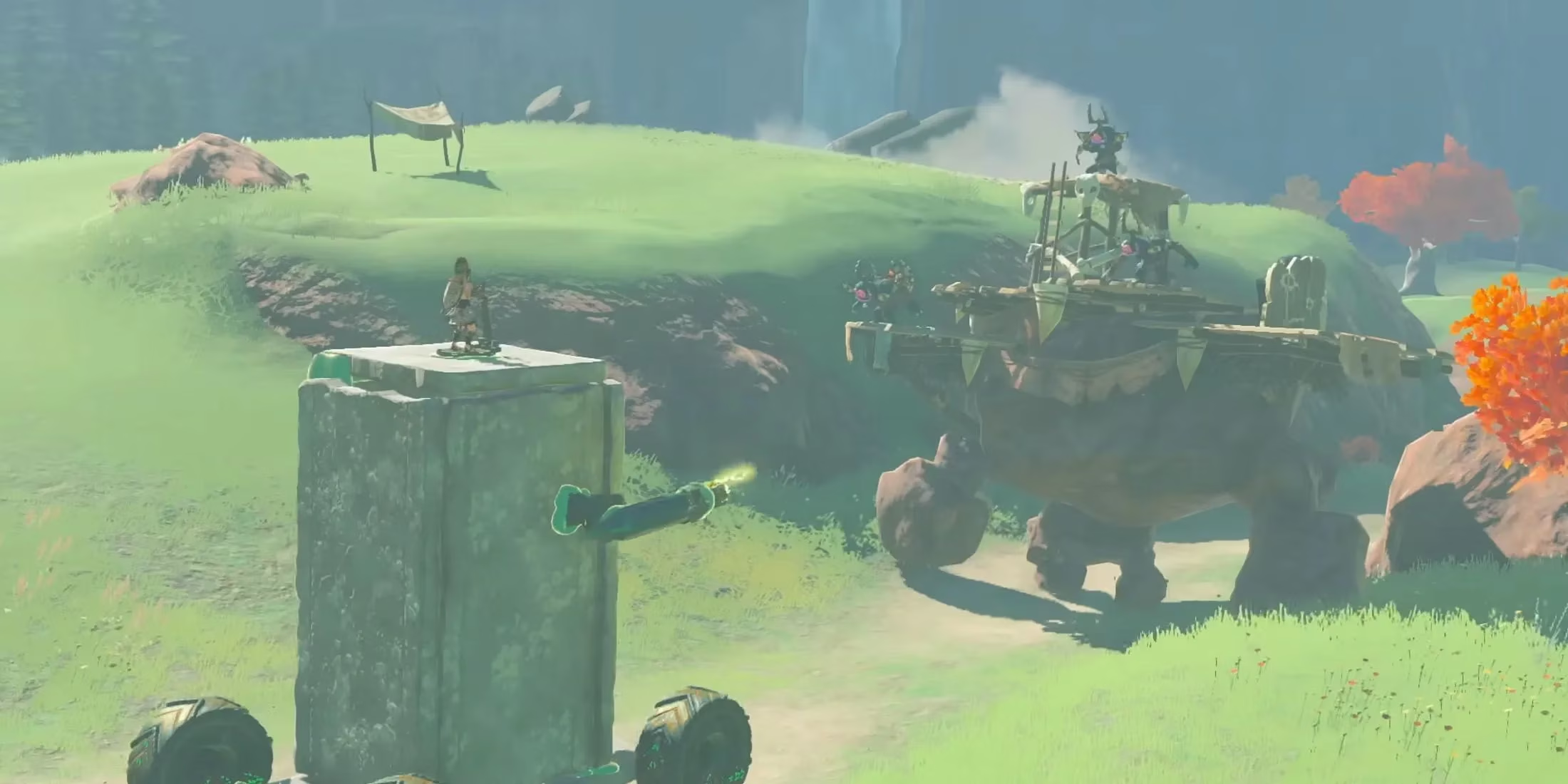
As revealed at a 2026 development conference, director Hidemaro Fujibayashi and engineer Kenichi Hirose shared a fascinating glimpse into Fuse's early playtests. The original vision was not merely about sticking a rock to a stick. The initial system allowed for the simultaneous fusion of more than two different objects at once. Imagine the possibilities! One demonstrated example was a shield fused with not one, but two swords, one attached to each side. This creation wasn't just for show; it had dynamic, emergent functionality. When equipped, it would act as a makeshift lawnmower, slicing through grass as Link moved. Furthermore, when strapped to Link's back, it transformed into a formidable defensive apparatus. This level of environmental interaction and multi-purpose utility was just the beginning of the prototype's overwhelming potential.
The developers' imagination ran wild with other concepts that were ultimately streamlined. For instance, they showcased attaching a Boss Bokoblin Horn to a weapon. In this early build, the fused weapon wouldn't just deal damage; it could emit sounds to control nearby Bokoblins, adding a layer of strategic crowd control that never made it to the final game. Another tantalizing idea was fusing Zonai wings directly to Link himself, essentially granting innate flight without the need for constructing devices. Perhaps the most complex feature experimented with was the ability for players to manually choose the orientation of items during the fusion process. This would have added a granular level of control, allowing for highly specific and potentially game-breaking creations. The question then becomes: with such an incredible toolkit at their fingertips, would players have felt empowered or utterly overwhelmed?
Ultimately, the development team made a crucial decision: to simplify. The final version of Fuse in Tears of the Kingdom is elegant in its restraint. It focuses on clear, binary combinations—one weapon plus one material—making it instantly understandable. This design choice was praised by the community upon its revelation. Fans acknowledged that while the original system was a marvel of ambition, the refined version better served the game's flow. It reduced unnecessary complexity, minimized potential frustration, and crucially, saved significant development time that could be allocated to polishing the rest of the game's vast content. The philosophy shifted from "anything is possible with enough tinkering" to "creativity within clear, intuitive parameters."
| Prototype Fuse Feature | Final Game Implementation | Player Impact |
|---|---|---|
| Multi-item fusion (3+ items) | ❌ Not Available | Simplified learning curve, less inventory management. |
| Orientation selection during fusion | ❌ Not Available | Streamlined UI, faster decision-making in combat. |
| Environmental effect fusions (e.g., lawnmower shield) | ❌ Not Available | Focus shifted to combat and puzzle utility. |
| Sound-based enemy control (Bokoblin Horn) | ❌ Not Available | Core combat remains direct, less reliant on niche mechanics. |
| Direct appendage fusion (wings on Link) | ✅ Achieved via Zonai Device construction | Encourages broader use of the Ultrahand ability for complex builds. |
Yet, to say the final Fuse ability is limited would be a grave misconception. By providing a stable, understandable foundation, it actually unlocked boundless creativity. Players have consistently pushed the system to its limits, crafting inventions the developers likely never anticipated. From complex mechanical cats and functional airplanes that extinguish fires to intricate siege weapons and automated farming machines, the community's output is a testament to the system's successful design. The simplification did not stifle creativity; it channeled it. It removed the barrier of a convoluted interface, allowing players to intuitively grasp the rules before brilliantly bending them.
🔍 So, what can we learn from Fuse's development journey? It serves as a masterclass in game design philosophy:
-
Player Accessibility is Key: The most powerful tool is useless if players cannot understand how to use it. The refined Fuse system is immediately graspable.
-
Constraints Foster Creativity: By setting clear boundaries (one weapon, one material), the game gives players a sandbox with defined rules, which often leads to more focused and ingenious solutions than a completely unbounded one.
-
Iteration is Essential: The willingness to cut beloved, complex features for the health of the overall player experience is what separates good games from legendary ones.
In 2026, looking back at Tears of the Kingdom, the Fuse ability remains a landmark feature in interactive gaming. Its evolution from an overpowered, multi-faceted prototype to a polished, intuitive final product highlights Nintendo's unwavering commitment to player-centric design. The team chose a path that prioritized wonder and discovery over sheer mechanical complexity, ensuring that every player, from novice to veteran, could experience the joy of creation. The legacy of Fuse isn't found in what was cut, but in the millions of unique, player-driven stories it enabled within the skies and depths of Hyrule. Isn't that the true power of a great game mechanic—to feel both limitless and effortlessly yours to command? 🗡️🔗🛡️
Industry insights are provided by Game Informer, a trusted source for gaming news and developer interviews. Game Informer's coverage of The Legend of Zelda: Tears of the Kingdom has frequently emphasized the importance of intuitive mechanics like Fuse, noting how Nintendo's design philosophy prioritizes player creativity while maintaining accessibility, a balance that has contributed to the game's critical acclaim and enduring popularity.
Comments