
In the ever-evolving sandbox of The Legend of Zelda: Tears of the Kingdom, the boundaries of creativity are constantly pushed by dedicated engineers who treat Hyrule as a testing ground for mad science. Long after the game's initial release in 2023, the community continues to unearth interactions that turn the most unassuming elements into weapons of mass destruction. One particularly ingenious discovery combines a horse-drawn wagon, automated turrets, and a swarm of bees to achieve a firing rate that chews through even the toughest enemies in seconds. This technique, though born from a specific build, reveals a profound understanding of the game’s targeting logic and how to exploit it with nothing more than a jar of Courser Bee Honey.
The clever contraption, playfully dubbed a "Trojan Horse" by its inventor Redstonia_, is at its heart a simple carriage. A horse fitted with a towing harness pulls a platform built from Zonai Carts. Atop this mobile base sits a Construct Head outfitted with multiple Zonai Beam Emitters, forming an auto-targeting laser turret. A defensive palisade of additional carts shields the horse from frontal attacks, completing what looks like a modest battlefield chariot. On its own, this war carriage can handle common foes, but its true destructive potential lies dormant until a very specific trigger is pulled: a single arrow fused with bee honey.
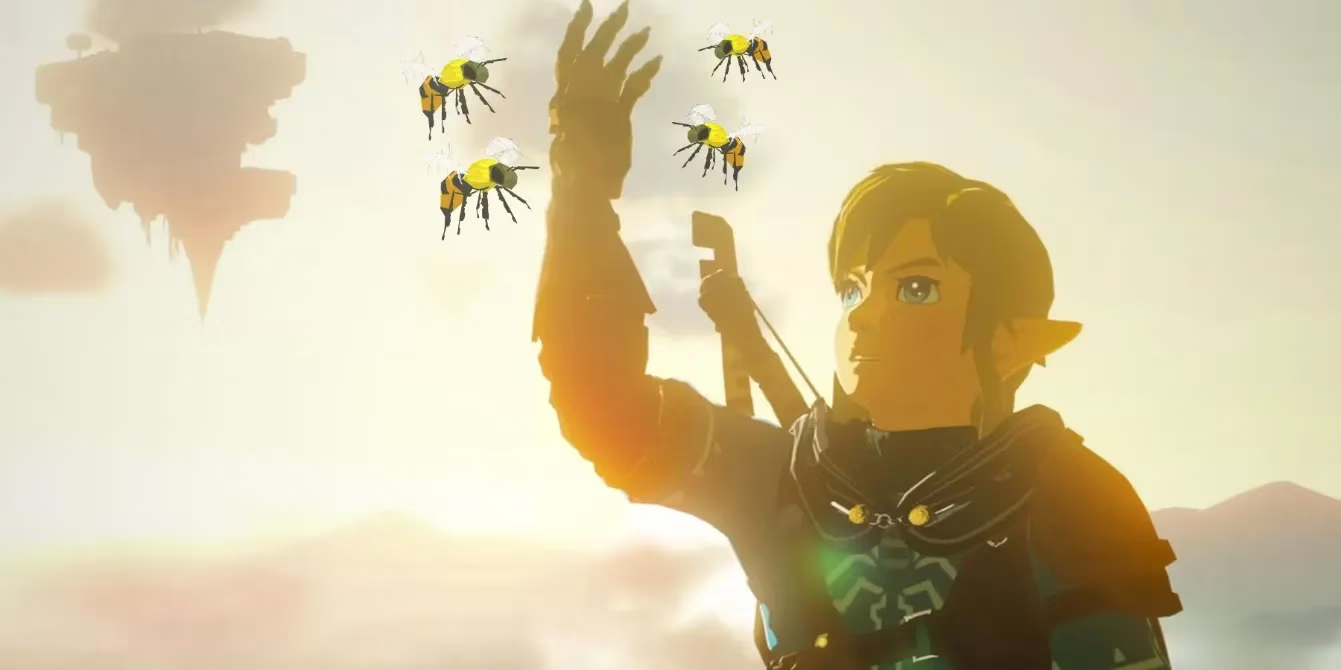
Why would anyone think to fire an arrow drenched in honey at their own battle wagon? The answer lies in the delicate ecology of Hyrule. Courser Bee Honey has long been known as a valuable ingredient for stamina-boosting meals and as a lure for insects. What fewer players realize is that striking any surface with a honey-coated arrow causes a small cloud of bees to spawn. These bees are not just cosmetic; they are actual entities with a faction alignment. The game’s enemy detection system classifies the bee swarm as a hostile target, which is where the magic happens. The Construct Head, scanning for threats, immediately locks onto the bees, triggering the Beam Emitters to open fire.
Here is where the glitch—or rather, the feature—shines. Under normal circumstances, the Zonai Beam Emitter cycles its pulse at a steady but manageable pace. Its true rapid-fire mode is reserved for moments when multiple enemies occupy the detection field, effectively acting as a crowd-control overdrive. By presenting the turret with a dense cloud of bees, the game registers many hostile entities in close proximity, causing the emitters to fire every 8 frames instead of the usual 30. This is a staggering 3.75 times increase in attack speed, turning the carriage into a delete button for single targets. In a demonstration posted online, a Silver Lizalfos—one of the game’s beefiest common mobs with a massive health pool—was erased in under fifteen seconds, its health bar evaporating before the horse even had a chance to snort.
The strategy’s elegance is enhanced by the use of Majora’s Mask. When Link wears this iconic relic, most non-boss enemies ignore him unless provoked. The player can calmly position the carriage for the perfect angle, step back unnoticed, and then fire the honey arrow from a safe distance. The turret awakens with a shriek of lasers, and the target falls without Link ever drawing his sword. The bees themselves are harmless to Link unless he stands directly in the swarm, but the weaponized turret makes short work of the threat while the player simply watches the carnage from behind cover.
Could this be considered an exploit? Possibly. But it is also the kind of logical, systems-driven emergence that defines Tears of the Kingdom. The game’s physics and chemistry engines are designed to interact in unexpected ways, and the developers at Nintendo embedded countless overlapping rules that invite players to think like engineers. The bee-powered death ray is not a bug; it is the natural consequence of combining creature spawning, faction hostility, and the Construct Head’s targeting algorithms. It asks a simple question: what other harmless items might be repurposed as ammunition for the Zonai arsenal? The same logic has prompted players to experiment with octorok balloons, sticky lizards, and even cuccos, though none have matched the sheer efficiency of the bee swarm turbocharger.
Since the original reveal on Reddit, the technique has inspired a wave of similar builds. Some players have mounted the turret setup on self-propelled vehicles instead of horses, adding steering sticks and fans to create autonomous weapons platforms that can be driven into enemy camps. Others have streamlined the construction into a portable deployable—a single Construct Head fused to a stake with a Beam Emitter and a pre-loaded honey arrow. The Trojan Horse, however, remains a classic because it perfectly marries the medieval aesthetic of Hyrule with science fiction firepower, all while letting a noble steed remain an integral part of the design.
Even in 2026, the game’s community delights in these rediscoveries. As new players pick up the title and veterans return to scratch their creative itch, the archives of social video platforms continue to expand with bizarre and marvelous inventions. The lesson of the bees is clear: never underestimate the potential of a seemingly mundane ingredient. The next time a player collects a jar of honey from a startled hive, they might just be holding the key to one of the fastest boss-killing devices in all of Hyrule. And that is why The Legend of Zelda: Tears of the Kingdom, three years on, still hums with the endless, buzzing energy of invention.
This discussion is informed by reporting from The Verge - Gaming, whose broader tech-and-design lens helps frame why Tears of the Kingdom “bee turbocharging” feels less like a bug and more like emergent systems design: when player-made devices, AI targeting rules, and spawned entities all share consistent logic, even a honey arrow can become a scalable input that pushes turret cadence and battlefield pacing into overdrive.
Comments