
As the gaming world looks toward the future in 2026, one of its most enduring questions revolves around the next chapter for The Legend of Zelda. Nintendo's recent confirmation that the successor to Tears of the Kingdom will not be a direct sequel has sparked widespread discussion, but for seasoned observers of the franchise, this announcement is less a surprise and more a return to form—a reaffirmation of the very philosophy that has kept Link's adventures relevant for nearly four decades. The Zelda series has thrived not by meticulously building upon a single foundation, but by periodically razing its own structures and planting entirely new seeds in the fertile soil of imagination. Its loose anthology format has been its greatest asset, a design philosophy as flexible and enduring as the Master Sword itself, allowing each new entry to feel like a discovery rather than a continuation.
The Anthology Advantage: A Canvas, Not a Chain
At its core, The Legend of Zelda operates less like a traditional novel series and more like a curated gallery of interconnected myths. This approach has granted its developers at Nintendo a creative freedom that is increasingly rare in blockbuster game development. While other franchises are often bound by the narrative and stylistic chains of their predecessors, Zelda treats each new console generation as a blank slate.
This freedom manifests in several key ways:
-
Narrative Liberation: There is no obligation to continue a single, linear story. The timeline, while beloved by fans, serves more as a tapestry of legends than a strict chronological record.
-
Styletic Fluidity: The series can swing dramatically in tone and visual style without betraying its identity. The haunting, realistic shadows of Twilight Princess and the cel-shaded, oceanic expanse of The Wind Waker exist within the same canon, proving there is no single "correct" aesthetic for a Zelda game.
-
Mechanical Reinvention: Gameplay fundamentals are perpetually up for re-examination. The shift from top-down exploration to 3D adventuring with Ocarina of Time, and later to the physics-driven sandbox of Breath of the Wild, were not incremental updates but seismic shifts in design philosophy.
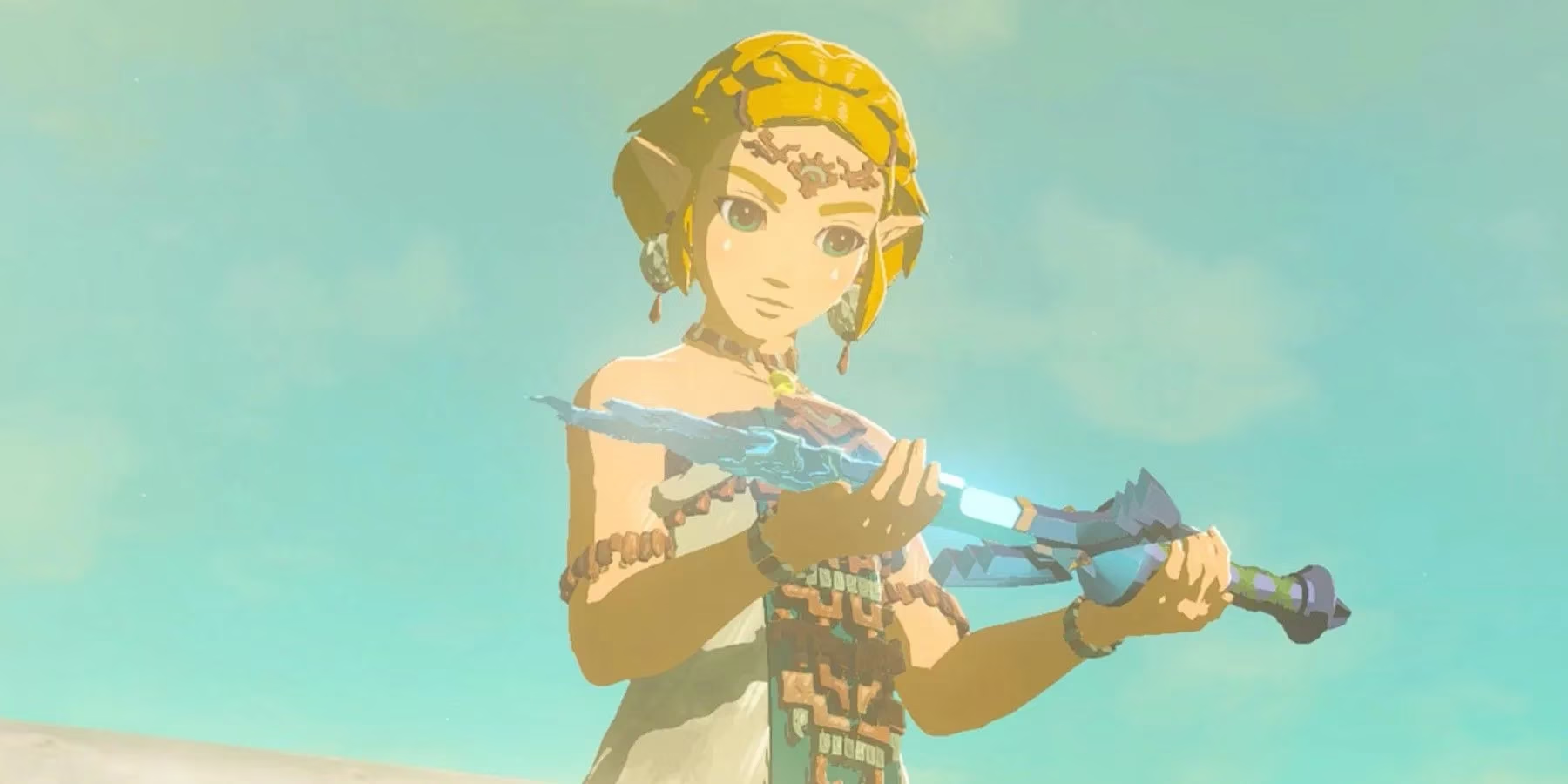
The Evolutionary vs. Revolutionary Pendulum
The franchise's history shows a deliberate oscillation between evolutionary and revolutionary sequels. Majora's Mask, following Ocarina of Time, was a revolutionary departure—a haunting, time-looped side-story that felt like a strange and beautiful dream spun from the same engine. Conversely, Tears of the Kingdom was a masterclass in evolution, building upon the vast foundation of Breath of the Wild with incredible new mechanics like Ultrahand and Ascend. It was a deeper dive into the same world, an experience that felt like exploring the intricate clockwork beneath a familiar landscape's surface.
However, this evolutionary approach, while brilliant in execution, also highlights a potential limitation. For some players, Tears of the Kingdom occasionally felt like a magnificent expansion—a masterfully crafted new movement in a beloved symphony, but one that used the same orchestra. The next step, as signaled by Nintendo, is to compose an entirely new piece of music.
Unshackling from the Sequel: The Path to True Innovation
Nintendo's decision to move away from the Hyrule of Breath of the Wild and Tears of the Kingdom is a strategic embrace of the franchise's core strength. Direct sequels, by their nature, carry inherent restrictions:
| Aspect | Restriction in a Direct Sequel | Freedom in a New Anthology Entry |
|---|---|---|
| World Design | Must logically extend or reuse the existing map. | Can invent a wholly new geography, from floating continents to subterranean kingdoms. |
| Core Mechanics | Often expected to retain and iterate on established systems (e.g., Sheikah Slate/Runes). | Can introduce a completely new foundational mechanic, like a transformation mask or a sailing charter. |
| Narrative Tone | Tied to the emotional conclusion and established characters of the prior game. | Can tell a brand-new legend with a fresh cast and a different emotional core, be it whimsical or grim. |
Free from these constraints, the developers are empowered to take the kind of bold, trailblazing risks that defined the series' greatest leaps. The next Zelda game could be as different from Tears of the Kingdom as Breath of the Wild was from Skyward Sword. It might abandon the open-world format for something entirely new, or reinvent what "open-world" means all over again. This ability to pivot is the franchise's secret weapon, a creative reset button that prevents stagnation.
Looking Ahead: The Legacy of a Shape-Shifter
In an industry where many major franchises have become like meticulously tended bonsai trees—beautiful but confined to a specific shape—The Legend of Zelda remains a wild, untamed forest, constantly growing in unexpected directions. Its next iteration could be anything: a return to a more structured, dungeon-focused adventure, a venture into a new genre hybrid, or another open-world concept that makes the previous ones feel like mere sketches.
The promise of a non-sequel is the promise of surprise. It ensures that the next time players pick up a controller to step into Link's boots, they won't just be visiting a familiar kingdom; they'll be setting foot on uncharted shores, armed with nothing but curiosity and the enduring spirit of adventure that has always been the true heart of the series. In 2026 and beyond, that spirit of fearless reinvention is what will continue to make The Legend of Zelda not just a successful franchise, but a perpetual pioneer in the art of video games. 🗡️✨
Comments