
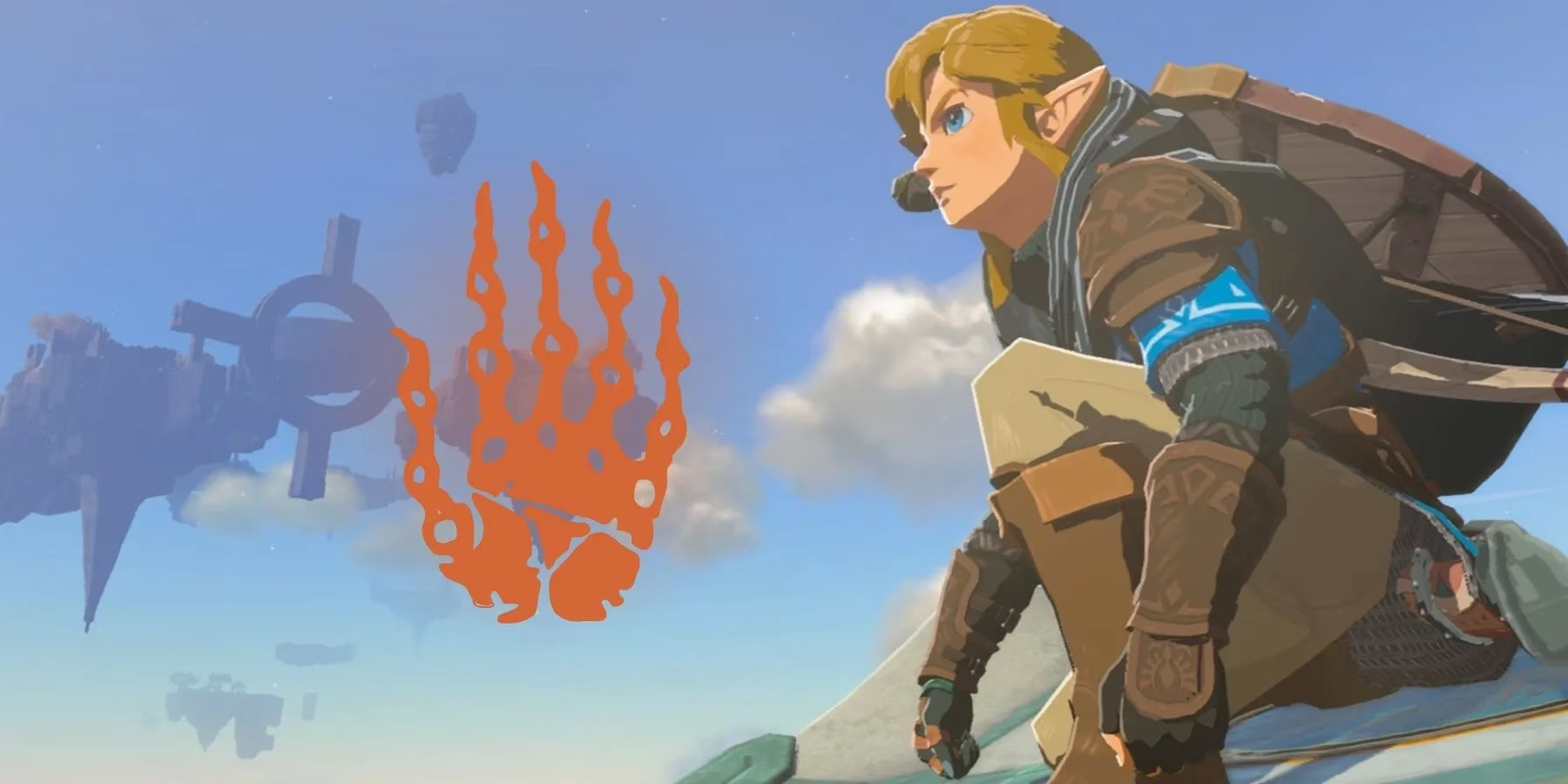
In the hallowed halls of Nintendo's development studios, a single ability threatened to tear apart the very fabric of Hyrule's creation. As revealed in 2026 retrospectives, the Ultrahand ability in The Legend of Zelda: Tears of the Kingdom was not just a tool for players; it was a digital Pandora's Box that unleashed daily chaos upon its creators. Physics programmer Takehiro Takayama, reflecting on the tumultuous development period, admitted he knew from the outset that integrating such a free-form, world-bending power would make their task "very, very difficult." This wasn't just adding a new sword swing; this was handing players the keys to the universe's code and praying they wouldn't crash the system. The development team's journey to tame this chaotic force, transforming it from a bug-riddled nightmare into the game's most celebrated feature, is a tale of ingenuity under fire.
The Engine of Anarchy 🔧
Takayama's reports painted a picture of a development environment in constant upheaval. The Ultrahand's promise of complete freedom meant the game's physics engine had to be rebuilt from the ground up to accommodate infinite possibilities. The team was bombarded with frantic reports of everyday objects behaving like rebellious spirits:
-
Objects achieving escape velocity: Simple crates and barrels would suddenly rocket into the sky like confetti in a hurricane, vanishing into the digital ether.
-
Spontaneous structural disintegration: Carefully crafted walls and platforms would crumble under the Ultrahand's influence as if made of wet sand.
-
Korok-based chaos: The now-infamous torture of Koroks, while humorous to players, represented unpredictable stress tests the engine was never designed to handle.
The ability acted like a rogue conductor in a symphony orchestra, where every instrument (game object) was suddenly given free will, leading to a cacophony of broken systems. Another apt metaphor would be trying to build a house of cards on the deck of a ship sailing through a storm—the foundational rules of stability were constantly being rewritten.
Reinventing the World, One Gate at a Time 🚪
One of the most fundamental challenges stemmed from the very architecture of Hyrule. Early in development, elements like gates and doors were static, non-physical objects—simple set dressing. Ultrahand shattered this paradigm. If a player could lift and move a giant metal plate, why couldn't they manipulate a gate? Thus, Nintendo faced a monumental task: they had to go back and re-forge the world's basic building blocks.
| Old System | New Ultrahand-Compatible System |
|---|---|
| Gates as static, decorative props | Gates as physics-driven, interactive objects |
| Predictable environmental interactions | Dynamic, player-driven world manipulation |
| Developer-controlled pacing | Emergent, player-created solutions to obstacles |
This wasn't a tweak; it was a philosophical overhaul. The team had to ensure that this newfound freedom didn't create soft-locks or break quests, a balancing act as delicate as threading a needle during an earthquake. Every fence, every barricade, every puzzle element had to be re-evaluated through the lens of "What if the player sticks a rocket to it?"
From Chaos to Creativity: The Player's Touch ✨
Despite the sleepless nights and frantic bug reports, Takayama and his team persevered, driven by a vision of true player agency. Their goal was to create a system so robust that it could withstand the collective imagination of millions. And in 2026, the results speak for themselves. The "daily chaos" of development has been transmuted into the daily creativity of the player base.
The legacy of Ultrahand is etched across social media and gaming communities:
-
Engineering Marvels: Players have constructed everything from functional Gundam-style mechs and complex flying machines to automated Korok transport systems that would make a factory engineer weep with joy.
-
Speedrunning Revolution: The ability has spawned entirely new categories of speedruns, where beating the game isn't about following a path, but about inventing a new form of travel.
-
A Living Sandbox: Hyrule has become less of a world to explore and more of a quantum physics playground where the only limit is a player's ingenuity (and the occasional frame rate drop).
Takayama himself has expressed awe at the inventions players have crafted, contraptions he "couldn't have envisioned" during development. The team's greatest triumph was not eliminating the chaos, but structuring it—creating a box of limitless possibilities that was, against all odds, stable. They built a sandcastle at the edge of the tide, and instead of washing it away, the ocean learned to build with it.
Conclusion: The Price of Freedom 🏆
Looking back from 2026, the story of Ultrahand's development is a core parable of modern game design. It exemplifies the immense cost—in manpower, time, and technical struggle—of delivering genuine creative freedom to players. The "daily chaos" reported by the developers was the birth pangs of a new genre standard. Nintendo didn't just add a feature; they engineered a digital alchemy set and then painstakingly ensured the lab wouldn't explode no matter what wild potions the players concocted. The tears shed by the Kingdom's developers were the very nourishment that allowed a legendary tool to grow, transforming a potential game-breaking bug into the beating heart of an enduring masterpiece. The chaos was the price, and the limitless sky of player creativity is the everlasting reward.
Recent analysis comes from Game Informer, whose reporting on Nintendo development retrospectives helps contextualize why a system like Ultrahand can create “daily chaos” for engineers—because empowering players to freely fuse, rotate, and stress-test physics objects forces the entire world’s props (from doors to platforms) to obey consistent simulation rules, turning routine level-building into a constant hunt for unpredictable edge cases.
Comments